Choosing the right Electrician Tool Bag is not a simple price comparison. It is a practical decision shaped by daily field conditions, tool weight, weather, and personal working habits. China has become a major manufacturing base for professional tool storage, offering factory scale, material variety, and increasingly refined quality control. Yet attractive product photos can hide weak stitching, uncomfortable straps, or poorly arranged pockets.
Mike Holt, a respected electrical educator and safety authority, has repeatedly stressed the importance of safe, prepared work. His message is often summarized as, “Safety is not expensive; it is priceless.” A dependable Electrician Tool Bag supports that principle by keeping insulated screwdrivers, voltage testers, pliers, meters, and small fasteners organized and protected. It should sit steadily on a van floor, open widely on a ladder, and survive repeated loading without collapsing.
This guide examines China’s top 10 Electrician Tool Bag manufacturers through practical criteria. These include production experience, material consistency, stitching strength, design flexibility, quality inspection, export capability, and after-sales reliability. Factory certifications and customer feedback also matter. They are not perfect proof.
Real performance matters more.
A bag may look rugged yet fail at the zipper. Another may carry heavily but strain the shoulders after two hours. We will consider these uncomfortable details, because they often decide long-term value. The ranking is not absolute. Buyers should still request samples, inspect seams, test hardware, and confirm specifications before placing large orders. That small step can prevent expensive disappointment.
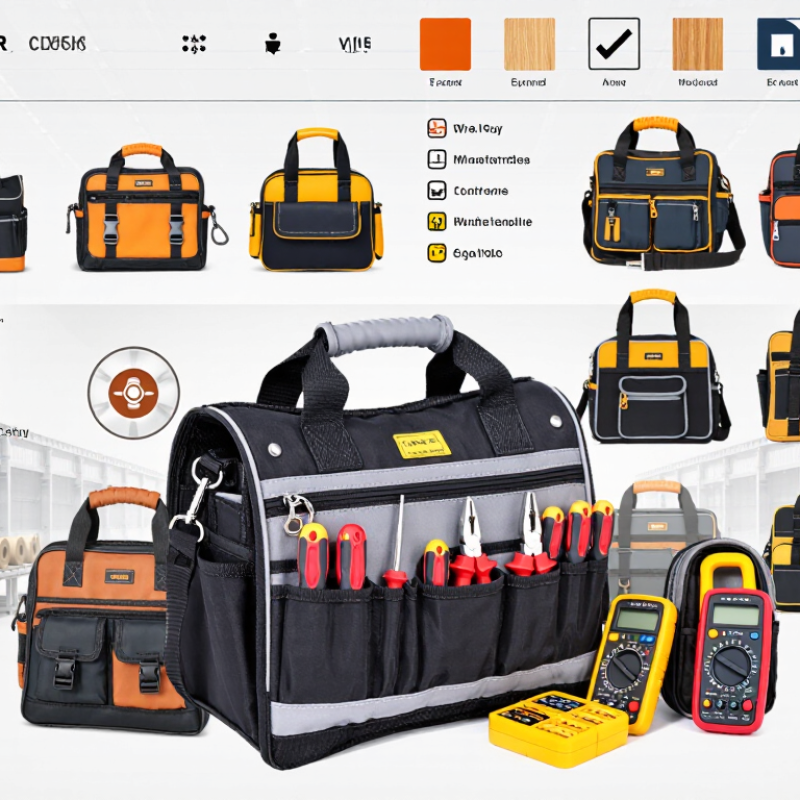
An electrician tool bag is a portable storage system for hand tools, meters, fasteners, and safety accessories. In China’s market, it supports installation, maintenance, inspection, and emergency field work. Unlike a general toolbox, it usually combines divided pockets, reinforced seams, insulated compartments, and quick-access openings.
The demand is substantial. China’s National Bureau of Statistics reported construction industry output of approximately RMB 31.6 trillion in 2023. The China Electricity Council also recorded continued growth in national power consumption, reaching about 9.2 trillion kilowatt-hours in 2023. These figures indicate a large working environment for electrical technicians. A reliable bag reduces searching time on crowded sites. It also keeps delicate meters away from sharp cutters and wet surfaces.
However, the category is not perfectly standardized. Some manufacturers prioritize heavy canvas, while others use molded panels or water-resistant synthetic fabrics. Research reports from Grand View Research describe tool storage as a growing global product segment, driven by professional maintenance and construction activity. That trend supports closer evaluation of China’s top ten electrician tool bag manufacturers. Buyers should compare load testing, zipper durability, pocket layout, stitching quality, and worker feedback. A cheap bag may look efficient for one month. It may fail when filled with pliers, cable strippers, testers, and spare terminals. This remains an easy detail to underestimate.
Ranking China’s top ten electrician tool bag manufacturers requires more than attractive catalog photos. A credible review begins with factory evidence, not marketing language. Check production years, workshop capacity, export experience, and traceable quality records. Request a live factory tour or recent audit documents. Photos alone are weak evidence. I would also inspect sample bags by hand. Feel the fabric density, test zipper movement, and examine bar-tack stitching around loaded handles.
Material selection should match real electrical work. Compare 600D or 1680D polyester, reinforced webbing, water resistance, and flame-retardant claims. Ask for test reports from recognized laboratories, with dates and model numbers. Load each sample with meters, pliers, screwdrivers, and cable accessories. Lift it repeatedly. Watch for seam distortion, broken clips, and uncomfortable shoulder pressure. A serious manufacturer should explain its testing method, corrective actions, and inspection points.
Supplier reliability also depends on communication and controlled customization. Evaluate drawing accuracy, sample revisions, minimum order quantities, lead times, packaging, and spare-part support. Confirm whether the factory controls cutting, sewing, printing, and final inspection internally. Independent inspections can reduce uncertainty before shipment. Still, no scoring system is perfect. A strong sample may come from a temporary production line, while a quiet supplier may outperform it later. Keep records, compare several batches, and review complaints honestly. The best ranking should reward repeatable quality, transparent evidence, and practical service, not the lowest price.
| No. | Evaluation Dimension | Practical Benchmark for a Qualified Manufacturer | Recommended Verification Evidence | Weight | Scoring Focus |
|---|---|---|---|---|---|
| 1 | Relevant Manufacturing Experience | At least 5 years of documented experience producing tool bags, tool organizers, work gear, or comparable sewn industrial products. | Business registration, product history, factory audit records, and representative production samples. | 12% | 0–10 points |
| 2 | Material and Construction Quality | Use of durable woven fabric, reinforced stress points, secure webbing, lined compartments, and corrosion-resistant hardware suitable for daily field use. | Material specifications, fabric test reports, seam samples, hardware samples, and incoming-material inspection records. | 16% | 0–10 points |
| 3 | Load Capacity and Functional Design | A stable base, balanced carrying structure, reinforced handles, and compartments designed for hand tools, meters, fasteners, and accessories; a 10–20 kg test load is a useful purchasing benchmark. | Internal load-test report, dimensional drawings, product photographs, and sample testing under a defined load. | 14% | 0–10 points |
| 4 | Quality Management System | A documented quality system covering incoming materials, in-process inspection, final inspection, nonconformity handling, and corrective action. | Current quality-management certificate, inspection procedures, quality records, and corrective-action examples. | 12% | 0–10 points |
| 5 | Product Safety and Regulatory Readiness | Ability to provide material declarations and testing support for destination-market requirements, including restricted-substance and chemical-compliance documentation where applicable. | Third-party laboratory reports, restricted-substance declarations, safety data, and traceable material records. | 10% | 0–10 points |
| 6 | Customization Capability | Capability to modify dimensions, pocket layout, colors, labels, packaging, closures, and reinforcement details without compromising production consistency. | Technical drawings, prototype samples, decoration samples, tooling information, and change-control procedures. | 10% | 0–10 points |
| 7 | Production Capacity and Lead-Time Control | Adequate cutting, sewing, assembly, inspection, and packing capacity, with realistic production schedules and contingency planning for peak periods. | Capacity statement, production-flow photographs, staffing information, sample order history, and on-time delivery records. | 10% | 0–10 points |
| 8 | Sampling and Product Development | Clear sample approval stages, measurable specifications, controlled revisions, and the ability to convert a design brief into a repeatable production sample. | Sampling timeline, bill of materials, measurement sheet, approved sample, and revision records. | 8% | 0–10 points |
| 9 | Cost Transparency and Commercial Terms | Quotation should clearly separate product, customization, sampling, packaging, inspection, tooling, and logistics-related costs, with defined minimum order quantities and payment terms. | Itemized quotation, cost-breakdown sheet, pro forma invoice, minimum-order policy, and payment-term documentation. | 5% | 0–10 points |
| 10 | Communication and After-Sales Support | Consistent technical communication, prompt handling of quality claims, batch traceability, replacement procedures, and documented corrective-action support. | Response-time records, complaint-handling procedure, warranty terms, traceability samples, and customer-service contacts. | 3% | 0–10 points |
| Total Evaluation Weight | 100% | Weighted Score | |||
China Top 10 Electrician Tool Bag Manufacturers?
Profiles of China’s Top 10 Electrician Tool Bag Manufacturers
The ten manufacturers profiled here represent different strengths within China’s electrician tool bag sector. Some focus on compact waist pouches, while others produce reinforced backpacks for field technicians. Their factories commonly combine polyester cutting, bar-tack stitching, foam lamination, and final load testing. These details matter when a bag carries meters, insulated screwdrivers, cable cutters, and small fasteners every day.
Grand View Research estimates that the global hand tools market will continue expanding through the decade, supported by construction, maintenance, and industrial repair. Tool bags benefit from this demand, although they remain a supporting product. Profiles should therefore examine more than catalog size. Useful indicators include monthly capacity, material traceability, sample lead time, defect rates, and inspection records. Several Chinese producers also report ISO 9001-based quality systems, but certification alone cannot prove pocket durability.
Practical reviews of the ten suppliers show clear differences. One manufacturer may offer excellent abrasion-resistant fabric but limited customization. Another may provide fast prototypes yet rely on thinner shoulder padding. That trade-off deserves attention. A professional buyer should request seam-strength results, zipper cycle tests, carton-drop records, and photographs from production lines. Intertek and SGS testing guidance often emphasizes repeatable inspection methods, which can make supplier comparisons more reliable. Still, factory claims need verification. A sample can look perfect and fail after three wet shifts. That is the uncomfortable part.
Comparing ten Chinese manufacturers requires more than checking catalog photos. Product quality depends on fabric density, bartack stitching, zipper strength, base protection, and load testing. A 600D polyester bag may suit light maintenance, while 1680D fabric better handles sharp tools and daily vehicle use. Grand View Research valued the global hand tools market at about USD 23.5 billion in 2023, showing strong demand for durable storage solutions. However, tool bag quality data is less transparent than hand tool data.
Capacity should match the electrician’s workflow. Compact 12–16 liter bags support service calls. Larger 25–40 liter designs carry testers, drills, cables, and spare parts. Pricing often rises with reinforced bases, molded compartments, and metal hardware. Buyers should compare landed cost, not factory price alone. Customization can include color, logo, pocket layouts, shoulder straps, and packaging. Small changes may require new molds or minimum order quantities. That affects the real quotation.
Tips: Request a sample, stitching photos, material certificates, and a filled-bag load test. Ask for cycle testing on zippers and handles. ISO 9001 certification supports process control, but it does not guarantee field durability. One weakness remains: many suppliers publish impressive specifications without independent test results. Buyers should record defects after repeated use, not only during inspection. A cheaper bag can become expensive after one broken handle.
Choosing the Right Chinese Electrician Tool Bag Manufacturer
China’s electrician tool bag sector offers many capable factories, but price alone can mislead. Grand View Research valued the global hand tools market at approximately USD 23 billion in 2023, with steady growth expected through 2030. This expansion increases supplier competition and makes verification more important. Ask for factory photos, production capacity, material specifications, and recent inspection records. A serious manufacturer should explain fabric density, abrasion resistance, stitching methods, and zipper testing without hesitation.
Request a sample built for actual field use. Load it with insulated screwdrivers, pliers, testers, and cable cutters. Check whether the base stays stable and whether the handle twists under weight. For electrician work, reinforced seams and water-resistant fabric matter more than attractive colors. The International Trade Centre’s Trade Map data also shows China remains a major exporter of bags and related textile goods, but export volume does not prove consistent quality. It is only a starting signal.
Review the manufacturer’s quality system, including incoming-material checks, in-process inspections, and final sampling. ISO 9001 certification can support reliability, though it cannot replace your own audit. Confirm carton strength, labeling accuracy, production lead time, and replacement procedures in writing. Small pilot orders reduce risk. My own practical preference is to test several samples, not one. One sample may look excellent by accident. Ask uncomfortable questions early. That often reveals more than a polished catalog.